Article Introduction
Understanding poker hands ranking is the foundation of becoming a better poker player. Whether you’re sitting at a casino table, joining an online tournament, or playing a friendly game with friends, knowing which hands beat others helps you make smarter decisions and avoid costly mistakes.
Many beginners memorize the hand rankings but struggle to recognize them during actual gameplay. Others know the names but don’t understand how ties are broken or why certain hands are much rarer than others.
This guide explains every poker hand in order, from the strongest to the weakest. You’ll also learn practical examples, common mistakes, probability insights, and strategic tips that can help you play with greater confidence.
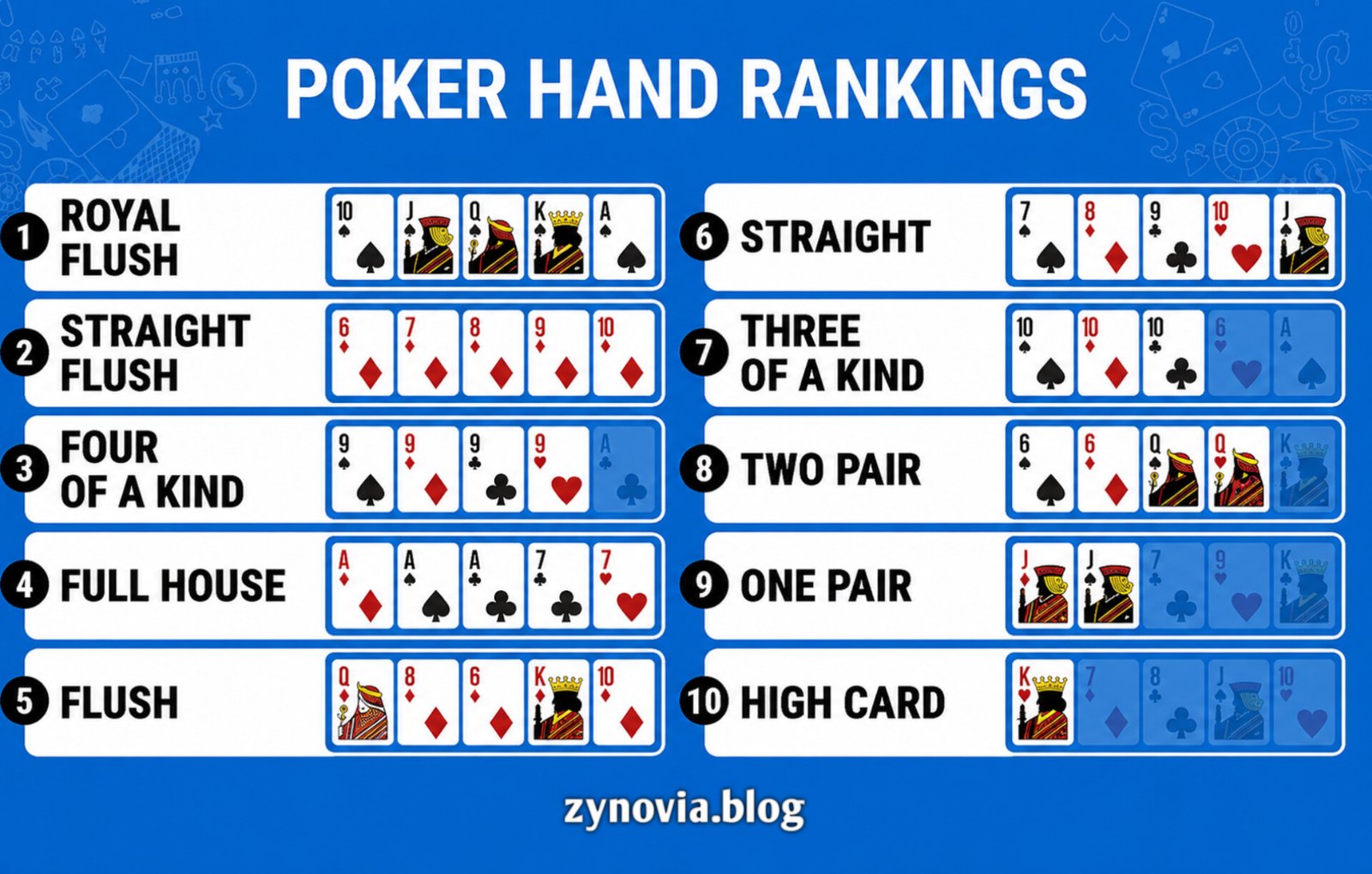
Complete Poker Hands Ranking (Highest to Lowest)
Below is the standard poker hands ranking used in Texas Hold’em, Omaha, Seven-Card Stud, and most popular poker variants.
Royal Flush
Straight Flush
Four of a Kind
Full House
Flush
Straight
Three of a Kind
Two Pair
One Pair
High Card
The higher-ranked hand always wins unless both players hold the same hand type, in which case kicker cards determine the winner in many situations.
Royal Flush
A Royal Flush is the highest possible hand in poker.
Cards
Ace
King
Queen
Jack
Ten
All five cards must belong to the same suit.
Example
A♠ K♠ Q♠ J♠ 10♠
There is no hand capable of beating a Royal Flush. If two players somehow make a Royal Flush, the pot is split because both hands are identical.
Why It Matters
This hand is incredibly rare. Most players may never receive one in thousands of poker sessions.
Straight Flush
A Straight Flush consists of five consecutive cards of the same suit.
Example
9♥ 8♥ 7♥ 6♥ 5♥
A higher Straight Flush beats a lower one.
For example:
King-high Straight Flush beats Queen-high Straight Flush.
Any Straight Flush loses only to a Royal Flush.
Four of a Kind
Also called “Quads,” this hand contains four cards of identical rank.
Example
K♠ K♦ K♥ K♣ 5♠
If two players have Four of a Kind, the higher four matching cards win.
For example:
Four Aces beat Four Kings.
Four Tens beat Four Nines.
If both players somehow share the same quads using community cards, the kicker determines the winner.
Full House
A Full House combines:
Three cards of one rank
Two cards of another rank
Example
Q♠ Q♦ Q♣ 8♥ 8♠
When comparing Full Houses:
Compare the three-of-a-kind first.
If equal, compare the pair.
For example:
AAA KK beats KKK AA because the three Aces are higher than three Kings.
Flush
A Flush consists of five cards of the same suit that are not consecutive.
Example
A♦ J♦ 9♦ 6♦ 2♦
When two players have a Flush:
Highest card wins.
If tied, compare the next highest card.
This continues until a winner is found.
Straight
A Straight contains five consecutive cards of mixed suits.
Example
10♣ 9♦ 8♥ 7♠ 6♦
Suits do not matter.
The Ace can be:
High: A K Q J 10
Low: A 2 3 4 5
The lowest possible straight is called the “Wheel.”
Three of a Kind
Often called “Trips” or “Set” depending on how it’s made.
Example
7♣ 7♦ 7♥ K♠ 3♣
If multiple players have Three of a Kind:
Higher three matching cards win.
Kickers break ties when needed.
Two Pair
Two Pair includes:
Two cards of one rank
Two cards of another rank
One kicker
Example
J♠ J♦ 6♣ 6♥ A♠
Comparison order:
Highest pair
Second pair
Kicker
This rule often surprises beginners.
One Pair
One Pair is exactly what it sounds like.
Example
A♠ A♦ 9♣ 6♥ 3♠
Most poker hands end with one player holding a single pair.
Tie-breaking follows this order:
Higher pair
Highest kicker
Second kicker
Third kicker
High Card
If no player forms any recognized poker hand, the highest individual card determines the winner.
Example
A♣ J♠ 9♥ 6♦ 3♣
Since no combination exists, the Ace gives this hand the advantage over King-high or Queen-high hands.
Poker Hands Ranking Chart
| Rank | Poker Hand | Beats |
|---|---|---|
| 1 | Royal Flush | Everything |
| 2 | Straight Flush | Four of a Kind and below |
| 3 | Four of a Kind | Full House and below |
| 4 | Full House | Flush and below |
| 5 | Flush | Straight and below |
| 6 | Straight | Three of a Kind and below |
| 7 | Three of a Kind | Two Pair and below |
| 8 | Two Pair | One Pair and High Card |
| 9 | One Pair | High Card |
| 10 | High Card | Nothing |
How Poker Tie Breakers Work
Many players believe identical hand names automatically result in a split pot. That isn’t true.
Here are the general rules:
Higher Rank Wins
Three Queens always beat Three Jacks.
Compare Highest Card
When both hands are Flushes or High Cards, compare the highest card first.
Use Kickers
Kickers become important with:
One Pair
Two Pair
Three of a Kind
Four of a Kind
Split Pot
The pot is divided only when every relevant card is identical.
Poker Hands Probability
Knowing how often hands appear helps you understand their strength.
| Hand | Approximate Odds |
|---|---|
| Royal Flush | 1 in 649,740 |
| Straight Flush | 1 in 72,193 |
| Four of a Kind | 1 in 4,165 |
| Full House | 1 in 694 |
| Flush | 1 in 509 |
| Straight | 1 in 255 |
| Three of a Kind | 1 in 47 |
| Two Pair | 1 in 21 |
| One Pair | 1 in 2.37 |
| High Card | 1 in 2 |
Rare hands naturally deserve stronger betting because opponents are much less likely to hold a better combination.
Common Beginner Mistakes
Misreading the Board
Always check all five community cards before deciding your hand.
Ignoring the Kicker
Two players can both have a pair of Aces, but the kicker often decides the winner.
Forgetting Flushes Beat Straights
Many new players mistakenly think a Straight outranks a Flush.
The correct order is:
Full House > Flush > Straight
Confusing Trips and Sets
Although both are Three of a Kind, poker players often distinguish them:
Set: Pocket pair plus one community card
Trips: One hole card plus paired board
The ranking remains identical.
Tips to Remember Poker Hands Ranking
Memorize the Order
Repeat the rankings until recalling them becomes automatic.
Practice with Free Games
Many online poker platforms offer free tables where you can recognize hands without risking money.
Use Printable Charts
Keeping a poker hands ranking chart nearby helps reinforce memory during practice.
Focus on Patterns
Instead of memorizing names alone, recognize visual patterns like:
Five same suit = Flush
Five consecutive cards = Straight
Three plus Two = Full House
Pattern recognition speeds up decision-making.
Why Poker Hand Rankings Matter
Poker isn’t only about luck. Every betting decision depends on accurately judging the strength of your hand compared with your opponent’s possible holdings.
Strong players quickly identify:
Winning hands
Drawing hands
Bluff opportunities
Pot odds
Risk versus reward
Learning the rankings thoroughly creates a solid foundation for developing these advanced skills.
Poker Hands Ranking in Texas Hold’em
Texas Hold’em follows the standard poker hand rankings.
Each player receives:
Two private cards
Five community cards
Players make the best possible five-card hand using any combination of the seven available cards.
This means your final hand may use:
Both hole cards
One hole card
No hole cards at all
Understanding this flexibility prevents many beginner mistakes.
What is the highest poker hand?
A Royal Flush is the highest possible poker hand. No other hand can beat it.
Does a Flush beat a Straight?
Yes. A Flush always ranks higher than a Straight.
Which is stronger: Three of a Kind or Two Pair?
Three of a Kind beats Two Pair every time.
Can two players have the same winning hand?
Yes. If both players have identical five-card hands, the pot is split equally.
Is Ace always the highest card?
Usually yes, but it can also act as the lowest card when forming the straight A-2-3-4-5.
Do poker hand rankings change between poker games?
Most popular variants, including Texas Hold’em, Omaha, and Seven-Card Stud, use the same standard hand rankings. Some specialty games may use different ranking systems, so it’s always worth checking the rules before you play.